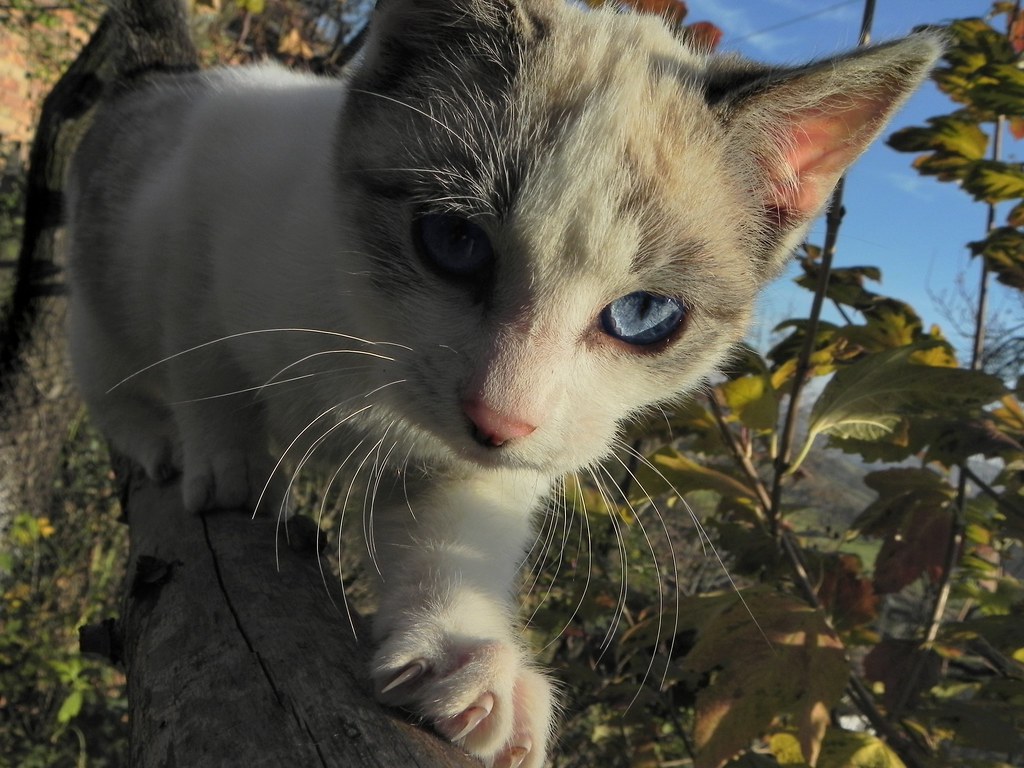
Let me start by saying that this is a great digital camera. It's actually a "bridge", which means that it's still a "compact camera", but it has DSLR features. I have chosen this camera after a long period of research- about a month of reading reviews, descriptions, viewing samples and comparing it to other bridges. In a very short period of time I concluded that its main competitor is Fujifilm HS10.
At a slightly higher cost I could get a "better"-packed-with-features camera, but the differences weren't as high as to convince me, especially that I wanted to stick with Nikon for a first camera. There are several major differences: HS10 has support for an external flash while P100 hasn't, it can shoot RAW while P100 doesn't and if I correctly remember it works on AA batteries while P100 has its own standard battery.
But everywhere I checked Nikon P100 obtained the highest score.
I must admit, my first photograph was taken using the "Auto Mode", which is basically a point&shoot mode: you won't be bothered by any settings. My second photo was already made using the "Program" Mode, but if beginners buy this camera it will be much easier to operate with it in auto mode.

The main attractive feature is of course the 26x optical zoom(26-678 mm), which is amazing! Similar lenses for DSLRs would cost at least as much as P100 itself. Some will say this is literally a spy camera, and I agree! It's particularly useful when you can't physically move from your spot to get closer to the subject you're photographing. An eloquent example is the following shot I took of the moon:


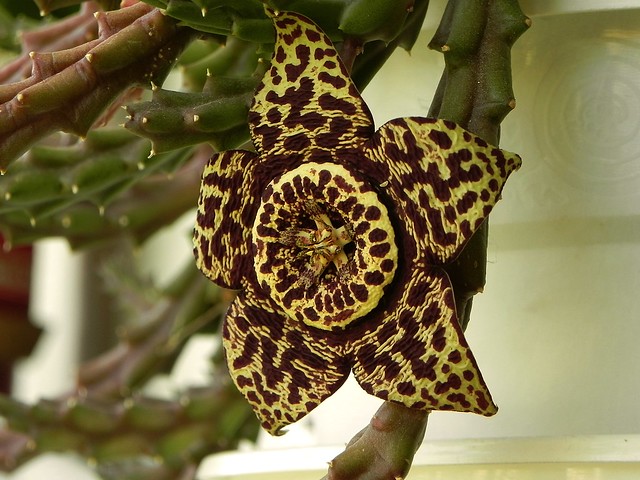
 The camera also has excellent macro capability. The specification says it has 1cm macro but that is partially true, it can do more than that! The trick is to increase a bit the focal(to zoom in a bit), and operate the focus manually. In this way I've discovered you can actually focus beyond the lens! That means that at a point, you can actually focus on the dust on the exterior glass- but it can go beyond that(which is not really useful anyway). Theoretically this is amazing, but in practice you'll rarely shoot such macros.
Long exposure times are bit disappointing: only 8 seconds. 20-30 seconds during a night shot would be nicer. The fast exposure is satisfying: 1/2000s. Although you can capture very fast movement, you also need plenty of light. Sometimes, even in bright sun 1/2000s exposed photos can look a bit dark, so you will probably need to increase that ISO sensitivity. Talking about ISO, it gives nice results until ISO1600 which is already a bit noisy, and I suggest using 3200 only in extreme cases where the combination of other settings(exposure, aperture) won't produce the expected result.
In my opinion the final image has balanced colors, although in some cases you won't get the expected result- it's the light source fault. That's why you can set the white balance to something adequate. I tend to leave it to "Auto" most of the time, as it will produce great results. But in cloudy days I choose "cloudy", to add a bit more yellow tone to the image. Of course, indoor situations such as fluorescent lighting or incandescent have their own settings too( setting them properly is a must, otherwise you'll get an obviously too blue\yellowish image).
I sometimes ran into the problem of difficult lighting conditions, or I probably desired a different exposure for a certain subject. This is where I found pretty useful to ability to change how the camera calculates the exposure. The default is "Matrix", in which case it takes into account the whole scene. There is one called "center weighted" which calculates the exposure after the lighting conditions present in the middle of the canvas. But the one that is quite interesting and fun is "spot". This basically calculates the whole image exposure based on a point.
You can also set how the camera auto-focuses. Although it can auto-autofocus(odd term, I know), I tend to set it to "manual" so I can move the focus point anywhere I want in the canvas. Particularly useful when shooting static objects and you're unable for the moment to choose your position. Autofocusing can be "single"(half-pressed shutter button=>focusing) or FullTime, which means the camera will always look after a subject to focus to.
 You can't do any serious optimizing on the shots, other than a "Quick Retouch", which is basically a contrast and color enhancer. You can set your camera to take an additional photo with improved colours(more vivid), b&w etc. from the "Optimize image" menu(or you can manually set some settings yourself).
P100 features a "Scene Mode"(sounds familiar heh? most cameras have this mode nowadays...). Apart from the well known scene mods I must highlight a couple of them. The first one that comes to mind if the "Panorama Assist". It's pretty obvious what it does: it helps you shoot panoramas. So you basically select your direction of shooting, and then the exposure settings will remain the same for the rest of the shots. After each shot, a quarter of it will appear half-visible so you can align the new shot properly. It's a shame they didn't include auto-stitching in the camera. Fujifilm HS10 does this. Instead they threw a software on the CD that comes with the camera. Oh well, better than nothing I guess! :)
The second one is "Backlit scene HDR". It's useful when you have background light affecting your subject exposure. I haven't really had the occasion to test this function yet though.
Other modes include "Smart Portrait"- I use this a lot when taking pictures of people- and "Sport Continuous", which is useful if you want to capture a critical moment you can't anticipate in some kind of sport or any other thing.
There are also 3 other quite useless modes:
- "Scene Auto Selector": this one was either designed for dummies, or was thrown there to complete the selector wheel. It fails a lot in choosing the right scene mode.
-"Subject Tracking": Pleaaaseee..... unless you're leaving in a world full of contrast, this ain't gonna work!
-"User saved Settings": Right, this is not really useless, but I use it rarely and I find myself most of the times modifying the settings in program mode...
Have I talked about the movie shooting modes? Oh yeah! This camera is properly equipped to make some good home-movies, if you also have a tripod. It can shoot at a resolution of 1920x1080(Full HD!), with stereo sound. Now that is cool: most cameras have only one microphone, but this one has 2 mikes placed on top of it, near the flash.
But I consider the funniest feature the "high-speed" movie. It's actually filming at a QVGA resolution(I think, either way it's a low res) with 240 fps. Taking slow motion clips of facepalms and things like that can be really fun! I already made a "slow-motion" test I uploaded to Youtube immediately after I bought the camera.
Here it is:
So, in conclusion I must say again that this is a great camera and I'm satisfied of it. It helped me initiate into photography, and gave me the will to buy a DSLR in the feature.
Please visit my Flickr Slideshow to see my pictures, or just if you want to see some photo samples.
You can also visit my Panoramio page, to see some panoramas I've taken.
At a slightly higher cost I could get a "better"-packed-with-features camera, but the differences weren't as high as to convince me, especially that I wanted to stick with Nikon for a first camera. There are several major differences: HS10 has support for an external flash while P100 hasn't, it can shoot RAW while P100 doesn't and if I correctly remember it works on AA batteries while P100 has its own standard battery.
But everywhere I checked Nikon P100 obtained the highest score.
I must admit, my first photograph was taken using the "Auto Mode", which is basically a point&shoot mode: you won't be bothered by any settings. My second photo was already made using the "Program" Mode, but if beginners buy this camera it will be much easier to operate with it in auto mode.

The main attractive feature is of course the 26x optical zoom(26-678 mm), which is amazing! Similar lenses for DSLRs would cost at least as much as P100 itself. Some will say this is literally a spy camera, and I agree! It's particularly useful when you can't physically move from your spot to get closer to the subject you're photographing. An eloquent example is the following shot I took of the moon:

 The camera also has excellent macro capability. The specification says it has 1cm macro but that is partially true, it can do more than that! The trick is to increase a bit the focal(to zoom in a bit), and operate the focus manually. In this way I've discovered you can actually focus beyond the lens! That means that at a point, you can actually focus on the dust on the exterior glass- but it can go beyond that(which is not really useful anyway). Theoretically this is amazing, but in practice you'll rarely shoot such macros.
Long exposure times are bit disappointing: only 8 seconds. 20-30 seconds during a night shot would be nicer. The fast exposure is satisfying: 1/2000s. Although you can capture very fast movement, you also need plenty of light. Sometimes, even in bright sun 1/2000s exposed photos can look a bit dark, so you will probably need to increase that ISO sensitivity. Talking about ISO, it gives nice results until ISO1600 which is already a bit noisy, and I suggest using 3200 only in extreme cases where the combination of other settings(exposure, aperture) won't produce the expected result.
In my opinion the final image has balanced colors, although in some cases you won't get the expected result- it's the light source fault. That's why you can set the white balance to something adequate. I tend to leave it to "Auto" most of the time, as it will produce great results. But in cloudy days I choose "cloudy", to add a bit more yellow tone to the image. Of course, indoor situations such as fluorescent lighting or incandescent have their own settings too( setting them properly is a must, otherwise you'll get an obviously too blue\yellowish image).
I sometimes ran into the problem of difficult lighting conditions, or I probably desired a different exposure for a certain subject. This is where I found pretty useful to ability to change how the camera calculates the exposure. The default is "Matrix", in which case it takes into account the whole scene. There is one called "center weighted" which calculates the exposure after the lighting conditions present in the middle of the canvas. But the one that is quite interesting and fun is "spot". This basically calculates the whole image exposure based on a point.
You can also set how the camera auto-focuses. Although it can auto-autofocus(odd term, I know), I tend to set it to "manual" so I can move the focus point anywhere I want in the canvas. Particularly useful when shooting static objects and you're unable for the moment to choose your position. Autofocusing can be "single"(half-pressed shutter button=>focusing) or FullTime, which means the camera will always look after a subject to focus to.
 You can't do any serious optimizing on the shots, other than a "Quick Retouch", which is basically a contrast and color enhancer. You can set your camera to take an additional photo with improved colours(more vivid), b&w etc. from the "Optimize image" menu(or you can manually set some settings yourself).
P100 features a "Scene Mode"(sounds familiar heh? most cameras have this mode nowadays...). Apart from the well known scene mods I must highlight a couple of them. The first one that comes to mind if the "Panorama Assist". It's pretty obvious what it does: it helps you shoot panoramas. So you basically select your direction of shooting, and then the exposure settings will remain the same for the rest of the shots. After each shot, a quarter of it will appear half-visible so you can align the new shot properly. It's a shame they didn't include auto-stitching in the camera. Fujifilm HS10 does this. Instead they threw a software on the CD that comes with the camera. Oh well, better than nothing I guess! :)
The second one is "Backlit scene HDR". It's useful when you have background light affecting your subject exposure. I haven't really had the occasion to test this function yet though.
Other modes include "Smart Portrait"- I use this a lot when taking pictures of people- and "Sport Continuous", which is useful if you want to capture a critical moment you can't anticipate in some kind of sport or any other thing.
There are also 3 other quite useless modes:
- "Scene Auto Selector": this one was either designed for dummies, or was thrown there to complete the selector wheel. It fails a lot in choosing the right scene mode.
-"Subject Tracking": Pleaaaseee..... unless you're leaving in a world full of contrast, this ain't gonna work!
-"User saved Settings": Right, this is not really useless, but I use it rarely and I find myself most of the times modifying the settings in program mode...
Have I talked about the movie shooting modes? Oh yeah! This camera is properly equipped to make some good home-movies, if you also have a tripod. It can shoot at a resolution of 1920x1080(Full HD!), with stereo sound. Now that is cool: most cameras have only one microphone, but this one has 2 mikes placed on top of it, near the flash.
But I consider the funniest feature the "high-speed" movie. It's actually filming at a QVGA resolution(I think, either way it's a low res) with 240 fps. Taking slow motion clips of facepalms and things like that can be really fun! I already made a "slow-motion" test I uploaded to Youtube immediately after I bought the camera.
Here it is:
So, in conclusion I must say again that this is a great camera and I'm satisfied of it. It helped me initiate into photography, and gave me the will to buy a DSLR in the feature.
Please visit my Flickr Slideshow to see my pictures, or just if you want to see some photo samples.
You can also visit my Panoramio page, to see some panoramas I've taken.